UAE SIM Card Math Favors Prepaid Plan Over Airport Kiosk Markup
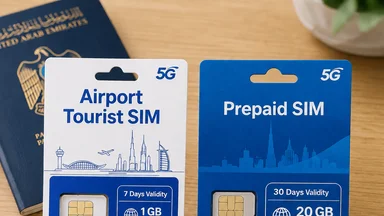
Landing at Dubai International Airport, the first thing many travelers see after baggage claim is the cluster of SIM card kiosks. Etisalat and Du, the UAE's two major carriers, offer tourist plans with a smile and a glossy brochure. The convenience is undeniable: hand over your passport, pay with a card, and within five minutes you have a working number. But that convenience comes at a cost. The markup on airport SIMs typically runs 30 to 50 percent above what you would pay for a comparable prepaid plan from the same carriers sold elsewhere in the city. For a traveler spending a week or more in the UAE, the difference can add up to a meal at a mid-range restaurant or a few extra dirhams for other experiences.
The Airport Kiosk Trap: Convenience with a Hidden Price Tag
The standard tourist SIM at a Du or Etisalat arrivals kiosk costs roughly 100 to 120 UAE dirhams (AED) for a 30-day plan. That usually includes between 5 and 10 gigabytes of data, plus some local minutes and a handful of international minutes. No local ID is required beyond your passport, which is a genuine convenience for short-stay visitors. But the data allowance is often lower than what you would get for the same money from a prepaid plan sold at a Carrefour or Lulu Hypermarket.
Take Du's Tourist Plan as of early 2026: 105 AED for 5GB of data, 100 local minutes, and 20 international minutes, valid for 28 days. That works out to roughly 21 AED per gigabyte. Meanwhile, a Du prepaid SIM from an electronics store might cost 85 AED for 10GB, with free local calls and no contract. That is roughly 8.5 AED per gigabyte — less than half the cost per gigabyte. The airport plan is effectively charging a premium for the convenience of not having to find a shop.
Etisalat's airport offering follows a similar pattern. Their Tourist Plan runs about 115 AED for 10GB, valid for 30 days. Again, no local ID required. But the same 10GB from a prepaid Etisalat SIM bought at a neighborhood phone shop might cost 95 AED, with the added benefit of rollover data on some plans. The airport kiosk is essentially a convenience fee disguised as a SIM card.
The markup is not arbitrary. Airport kiosks pay high rent, operate long hours, and employ multilingual staff. That overhead gets passed to the customer. But for a traveler on a budget, the question is whether the 30 to 50 percent surcharge is worth avoiding a 15-minute detour to a hypermarket. For most, the answer is no.
Prepaid Plans: What You Get for the Same Money
Virgin Mobile UAE, a mobile virtual network operator (MVNO) that runs on Du's network, offers a compelling alternative. Their 30-day prepaid eSIM plan costs roughly 80 to 90 AED for 10GB of data, with unlimited local calls and texts. That is about 25 percent cheaper than the airport Du plan for double the data. Activation is done through the app, and you can top up with a credit card or voucher.
Du's own prepaid SIM, sold at electronics stores like Sharaf DG or online, typically costs 85 AED for 10GB with free local calls. Some plans include 20 international minutes as well. The validity is 30 days, not the 28 days of the tourist plan. That extra two days matters if your trip straddles a month boundary. Top-up is easy through the Du app or via recharge cards sold at most convenience stores.
Etisalat's prepaid offering, called "Wasel," starts at around 95 AED for 10GB with free local calls and 30 international minutes. The plan is valid for 30 days and can be recharged with data add-ons if you run out. Unlike the tourist SIM, the Wasel plan allows data rollover if you recharge before the expiry date — a feature that can save heavy users from buying extra data.
All these prepaid plans require registration with your passport and UAE visa page, but the process is straightforward. The shop assistant scans your passport, enters the details, and the SIM is active within minutes. For eSIMs, you upload a photo of your passport and visa online. The main difference from the airport kiosk is that you have to find a store or order online, which takes a bit of planning.
The Fine Print: Data Speeds, Throttling, and Validity
Not all data is created equal. Airport tourist SIMs from Du and Etisalat often throttle speeds after the first 1GB of daily usage. The fine print on Du's Tourist Plan states that after 1GB per day, speeds drop to 128 kbps — barely enough for WhatsApp messages, let alone streaming or video calls. Etisalat's tourist plan has a similar threshold, though the cap is sometimes 500MB per day on cheaper tiers.
Prepaid plans, by contrast, typically offer full-speed data until you hit your monthly cap. A Du 10GB prepaid plan gives you the full 4G or 5G speed for the entire 10GB. Once you exceed the cap, speeds may drop, but many plans allow you to buy a data add-on that restores full speed. This makes prepaid plans much more suitable for travelers who rely on maps, ride-hailing apps, or video calls.
Validity is another hidden difference. Du's Tourist Plan expires after 28 days, not 30. If you arrive on the 1st of the month, your SIM dies on the 28th. Etisalat's tourist plan is 30 days but starts from the day of activation. Prepaid plans from both carriers generally offer 30-day validity, and some allow you to extend by recharging before expiry. Virgin Mobile UAE's prepaid eSIM is also 30 days, with the option to buy a new plan at the end.
Data rollover is a feature that can save money on longer trips. Some Etisalat Wasel plans allow unused data to roll over for one month if you recharge before the expiry date. Du's prepaid plans do not always include rollover, but they offer data carryover on certain higher-tier packages. Check the terms when you buy. A plan that rolls over unused gigabytes can stretch a 10GB allowance into 15GB or more over a two-month stay.
Where to Buy a Prepaid SIM Without Getting Ripped Off
The best place to buy a prepaid SIM in the UAE is a hypermarket like Carrefour or Lulu Hypermarket. These stores have dedicated electronics sections that sell Du and Etisalat SIMs at official prices. A Carrefour in Dubai Marina or a Lulu in Deira will have the same SIMs as the airport kiosk, but without the markup. The staff are trained to handle registration, and the process takes about 10 minutes.
Small phone shops in areas like Deira, Bur Dubai, or Al Nahda also sell prepaid SIMs, often with a small commission of 5 to 10 AED. These shops can be useful if you need help with activation or want to buy a cheap handset. However, stick to well-known retailers or official carrier stores to avoid unexpected charges. Insist on a "prepaid" or "Wasel" SIM, not a "tourist" SIM.
Online ordering is the most convenient option if you have a local address. Du and Etisalat both offer home delivery within 1 to 2 hours in Dubai and Abu Dhabi. You upload your passport and visa page, pay by card, and the SIM arrives by courier. Virgin Mobile UAE's eSIM can be activated instantly from anywhere — you do not even need a physical SIM slot. This is ideal for travelers who want to be connected before they land.
For eSIMs, the process is even simpler. You buy a plan online, receive a QR code via email, and scan it with your phone's settings. No physical card, no waiting. The downside is that not all phones support eSIM, and some travelers prefer a physical SIM for backup. But for those with compatible devices, an eSIM from Virgin Mobile UAE or a global provider like Airalo can be cheaper than any physical SIM.
The Math: How Much You Actually Save
Let's run the numbers for a typical two-week trip. At the airport, a Du Tourist Plan costs 105 AED for 5GB. A Du prepaid SIM from Carrefour costs 85 AED for 10GB. That is a saving of 20 AED and double the data. For a month-long trip, the saving widens: 120 AED at the airport for 10GB vs. 95 AED for a prepaid Etisalat Wasel with 10GB and rollover. That is 25 AED saved, plus the possibility of rolling over unused data.
For an annual traveler who visits the UAE three times a year, the savings add up. Three airport SIMs at 120 AED each cost 360 AED. Three prepaid SIMs at 85 AED each cost 255 AED. That is a saving of 105 AED per year — enough for a decent meal at a mid-range restaurant. For a family of four, the savings multiply: four airport SIMs cost 480 AED; four prepaid SIMs cost 340 AED. That 140 AED difference can cover a desert safari or a day pass at a water park.
The savings are even larger if you switch to an eSIM. Virgin Mobile UAE's 30-day 10GB plan costs 80 AED, compared to 120 AED for the airport Etisalat plan with the same data. That is a 33 percent saving. For a family of four, the difference becomes 160 AED over a month. And because eSIMs can be bought before departure, there is no time wasted at the airport.
But the math is not purely financial. The airport SIM offers instant activation and no need to find a store. For a traveler arriving at midnight after a long flight, the convenience may be worth the premium. The key is to know the trade-off. If you can wait until morning, or if you have a pre-ordered eSIM, you keep the money in your pocket.
Data Staleness Warning: Check Prices Before You Go
Telecom plans in the UAE change frequently. Du and Etisalat adjust their tourist and prepaid offerings every few months, often in response to competition or regulatory changes. Virgin Mobile UAE revamped its plans in early 2025, introducing new data tiers and pricing. The prices cited in this article are from early 2026 and may be outdated by the time you read this.
To get current prices, check du.ae or etisalat.ae before travel. Reddit forums like r/dubai and r/UAE have recent threads where travelers share what they paid. Travel blogs and YouTube channels also post updates, but always verify against official carrier sites. A plan that looks cheap on a blog may have changed by the time you arrive.
The same caution applies to eSIM providers. Airalo and other global eSIM brands offer UAE plans, but their prices can be higher than local prepaid plans. Always compare the cost per gigabyte and check the validity period. Some global eSIMs expire after 7 or 15 days, which may not suit longer stays. Local prepaid plans are almost always cheaper for stays of a week or more.
Finally, remember that registration rules can change. The UAE requires all SIM cards to be registered with a valid passport and visa. In 2025, the Telecommunications and Digital Government Regulatory Authority (TDRA) introduced new biometric verification for some plans. Check the latest requirements before you travel to avoid being stuck without a working SIM.
Practical Takeaway: One Simple Rule for SIM Savings
The simplest rule for saving money on a UAE SIM card is this: never buy at the airport. The markup is too high, the data caps are too low, and the convenience is not worth the premium for most travelers. Instead, pre-order an eSIM before you depart, or buy a prepaid physical SIM from a hypermarket or phone shop after you arrive.
If you must buy at the airport because your flight lands late or you need immediate connectivity, at least choose the cheapest tourist plan available. Do not be upsold to a higher data tier — you can always top up later. And remember that the SIM can be activated only after you leave the arrivals hall, so there is no rush to buy it before you clear customs.
For those who travel frequently to the UAE, consider keeping a prepaid SIM from a previous trip and recharging it before your next visit. Du and Etisalat allow SIMs to remain active for up to six months without recharge in some cases. Check the expiry date on your old SIM; if it is still valid, a simple top-up can save you the registration hassle entirely.
Ultimately, the choice between an airport SIM and a prepaid plan involves trade-offs. The airport offers unmatched convenience for those arriving late or unfamiliar with the area, but the cost is higher. A prepaid plan saves money and often provides more data, but requires a bit of planning. For most travelers, the savings outweigh the inconvenience, but the right decision depends on your arrival time, budget, and tolerance for detours. For a similar cost-saving breakdown on visa paperwork, see our article on UK visa math, or for a different angle on Gulf travel, read about Oman Wadi Shab permits. Both follow the same logic: weigh convenience against cost, and choose what fits your trip.