Namibia Intercity Bus Math Favors Thursday Windhoek Departure Over Monday Weekend Wait
Most travel advice for Namibia starts with renting a 4x4 and hitting the gravel roads. That works if you have the budget and a driving partner. But for solo travelers or anyone watching costs, the intercity bus network offers a viable alternative—provided you time it right. The conventional wisdom says start your trip on a Saturday to maximize a week. In Namibia, that advice costs you money and comfort. A Thursday departure from Windhoek sidesteps weekend crowds, avoids premium accommodation rates, and aligns with the country's most reliable bus operator, Intercape. Here is the math and the itinerary that makes it work.
Thursday Departure Cuts Weekend Crowds and Hotel Overcharges
Windhoek to Swakopmund is the busiest bus route in Namibia. Intercape runs a daily service on this corridor, but the Friday and Monday buses are consistently full. Thursday seats, by contrast, are often half empty. That means you can usually book a window seat without hassle, and the bus departs on time—a non-trivial advantage in a country where schedules are approximate.
The financial incentive is clearer. Coastal lodges in Swakopmund frequently impose a two-night minimum stay on weekends, with rates climbing by 20 percent or more. A Thursday departure lets you check in on Friday, when many properties offer midweek pricing. You can book a single night at a lower rate, then move on. Weekend bus tickets to Swakopmund cost roughly N$250, while a Thursday ticket runs about N$180—a saving of nearly 30 percent.
Beyond cost, the Thursday midday departure from Windhoek arrives in Swakopmund before dark, around 4:30 PM. For solo travelers, especially women, arriving in daylight is safer and less stressful. The bus terminal in Swakopmund is small and well-lit, but the walk to a guesthouse is easier when the sun is still up. Weekend buses, delayed by cargo loading at Okahandja, often arrive after sunset.
Some travelers argue that the weekend atmosphere in Swakopmund is worth the premium—the cafes and beachfront are livelier. That is true if your goal is nightlife. But for most visitors, the trade-off of paying more for a busier experience does not hold. Thursday gives you Friday and Saturday in town anyway, with lower costs and fewer crowds.
Namibia's Bus Network: Three Corridors, One Reliable Operator
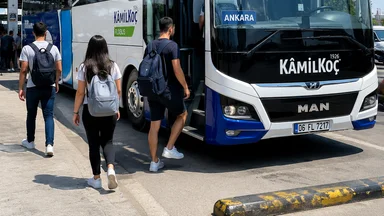
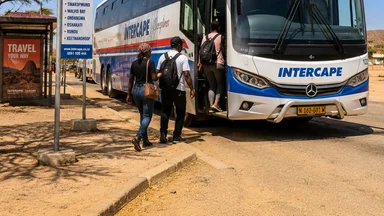
Intercape is the backbone of Namibia's intercity bus network. As of late 2024, it runs daily services on the Windhoek–Swakopmund–Walvis Bay corridor, which is the most traveled route. The buses are comfortable, with air conditioning and a toilet, and the journey takes roughly four hours. Tickets can be booked online or at the Windhoek station, though an online booking adds a small fee of around N$20.
The northern route, from Windhoek to Oshakati via Otjiwarongo and Tsumeb, runs three times a week—Monday, Wednesday, and Friday. This is the route to reach Etosha National Park, though you need a connecting shuttle from Tsumeb to the park's southern gate. The southern route to Keetmanshoop via Mariental takes about six hours and runs daily, but less frequently than the coastal line.
TransNamib, the state-owned rail operator, suspended passenger services in early 2023 due to infrastructure issues. That leaves buses as the only public transport option for long-distance travel. Insight Vacations charters fill some gaps, but they require advance booking and are not practical for spontaneous trips. For most travelers, Intercape is the default.
A lesser-known option is the local minibus network, which connects smaller towns. These are cheaper but less reliable, with no fixed schedules and often overcrowded. For a first-time visitor, sticking to Intercape is the safer choice.
Another operator worth mentioning is the City to City bus, which runs a Windhoek–Swakopmund service on Fridays and Sundays only. Their fares are about N$10–15 cheaper than Intercape, but the buses are older and lack onboard toilets. For the coastal route, the savings may not justify the discomfort, especially on a four-hour ride. However, if you are on a very tight budget and can tolerate a less comfortable journey, City to City is an alternative. Their Sunday departure from Windhoek is at 7 AM, which means an early start but arrival by noon—a trade-off against the later Intercape departure.
The Monday Weekend Wait: Why Starting Saturday Costs More
Arriving in Windhoek on a Saturday means paying peak rates for accommodation. Guesthouses in the city center average N$600 per night on weekends, compared to roughly N$400 midweek. A Thursday departure means you check into your Windhoek hotel on Thursday night at the lower rate, then head to the coast on Friday.
Weekend bus tickets are not just more expensive—they are also harder to get. Intercape's Friday and Monday buses often sell out by Wednesday. If you wait until Saturday, you might be stuck in Windhoek an extra day. The Sunday bus to Swakopmund exists but runs only once, early in the morning, which means a rushed start.
Restaurant prices in coastal towns rise noticeably on weekends. A typical dinner in Swakopmund might cost N$120 on a Tuesday but N$150 on a Saturday. That 20 percent markup adds up over a few days. The same applies to activities: sandboarding and dolphin cruises charge premium rates on weekends. For example, a sandboarding session in Swakopmund costs around N$350 on weekdays but jumps to roughly N$450 on Saturdays. Similarly, a dolphin cruise from Walvis Bay is about N$400 midweek versus N$500 on weekends. These markups are common across the tourism industry.
Perhaps the biggest hidden cost is time. Etosha National Park requires a permit, and the Monday morning queue at the southern gate can stretch to an hour. Arriving midweek, you walk straight in. The Thursday departure strategy lets you hit Etosha on a Tuesday or Wednesday, when the park is quieter and wildlife viewing is better due to less vehicle traffic. During peak season (June–October), the difference is even more pronounced: midweek visitation is roughly half of weekend numbers, according to park rangers.
Windhoek to Etosha: Timing the 7-Day Loop Without Rushing
A seven-day Namibia itinerary that starts on Thursday can cover Windhoek, Swakopmund, and Etosha at a humane pace. Day one is arrival in Windhoek. Spend the afternoon at the Alte Feste and the Namibia Craft Centre—both compact and walkable. Day two is a morning bus to Swakopmund, arriving by early afternoon. Explore the jetty and the German colonial architecture.
Day three: take an early bus back to Windhoek, then connect to a northbound bus to Tsumeb. This requires a tight transfer—allow at least two hours between buses. From Tsumeb, a shuttle runs to the Etosha southern gate. Book the shuttle through your accommodation; it costs roughly N$150 per person. Day four and five are inside Etosha. Self-drive is the best option; book a vehicle through Namibia Wildlife Resorts at the park entrance.
Day six: return bus from Tsumeb to Windhoek via Otjiwarongo. The bus leaves Tsumeb around 8 AM and arrives in Windhoek by early afternoon. Day seven is a buffer. Buses in Namibia run 30 to 60 minutes late on average, so do not schedule a flight on the same day as a bus arrival. Use the buffer to rest or see the National Botanic Garden.
This loop is tight but doable. Critics might say it is too rushed for Etosha—two days is minimal. True, but it is better than skipping the park entirely. If you have more time, add a day in Etosha by cutting Swakopmund short. Alternatively, you could skip the Swakopmund side trip entirely and spend three full days in Etosha, using the Thursday arrival to head straight north on Friday. That sacrifices the coast but gives you a more relaxed wildlife experience.
A common counter-argument is that the transfer from Windhoek to Tsumeb is too tight for comfort. Indeed, the bus from Swakopmund arrives in Windhoek around 4:30 PM, and the northbound bus to Tsumeb departs at 6 AM the next day. That means an overnight in Windhoek, which adds accommodation cost. However, you can avoid this by taking the Friday morning bus from Swakopmund to Windhoek (arriving 12:30 PM) and then catching the Friday afternoon bus to Tsumeb, which leaves Windhoek at 2 PM. This works only if the Friday bus to Tsumeb is running—it does, but it's a tight connection. Alternatively, book a direct shuttle from Swakopmund to Etosha through some lodges, which costs around N$400–500 per person but saves a day.
Fare Math: Single Tickets Beat Round-Trip on Two of Three Routes
Intercape's pricing structure is straightforward: single tickets cost the same as one leg of a round-trip. On the Windhoek–Swakopmund route, a single is N$180 and a round-trip is N$360—no discount. So buying two singles separately costs the same but gives you flexibility. If your plans change, you are not locked into a return date.
For Windhoek–Etosha (via Tsumeb), a single is N$220 and a round-trip is N$400. That is a slight loss of N$40 by buying a round-trip. Again, two singles are better. On the southern route to Keetmanshoop, a single is N$250 and a round-trip is N$450—saving N$50 if you are sure you will return. But that route is less traveled, and the round-trip might not be worth the commitment.
The online booking fee of N$20 per ticket is unavoidable if you want a guaranteed seat. Walk-up purchases are possible but risk sellouts, especially on weekends. The fee is small insurance. Some travelers prefer to buy at the station to avoid it, but then you gamble on availability.
A counter-argument: if you have a fixed itinerary and no intention of changing it, a round-trip saves you the hassle of booking twice. The math favors singles only if you value flexibility. For most visitors, the flexibility is worth more than the N$20–40 difference. Consider also that if you miss a bus, a single ticket is simply lost, while a round-trip might allow you to use the return leg later—but Intercape's round-trip tickets are typically valid for 30 days, so that's a small advantage.
Cheapest 14 Days: Windhoek, Coast, Desert, and Back by Bus
A two-week Namibia trip on buses can cover the highlights without breaking the bank. Week one: arrive in Windhoek on Thursday, spend three nights (Thursday–Saturday), then take the Friday bus to Swakopmund for four nights (Saturday–Tuesday). Accommodation in Swakopmund midweek is cheaper—guesthouses run about N$300 per night.
Week two: from Swakopmund, take a day trip to Sossusvlei. The bus to Sesriem runs only on Tuesdays and Thursdays, so plan accordingly. The ride takes about five hours. Stay at a desert camp near Sesriem for N$300 per night, book at least two weeks ahead. Spend two nights there, then take the Thursday return bus to Windhoek. The Windhoek–Sesriem bus fare is roughly N$300 each way.
Total transport for 14 days: Windhoek–Swakopmund (N$180), Swakopmund–Sesriem (N$300), Sesriem–Windhoek (N$300), plus local shuttles—under N$1,500. Accommodation averages N$300–400 per night, totaling roughly N$4,200 for 14 nights. Food and activities add perhaps N$3,000. A 14-day budget of N$9,000 (about US$500) is realistic.
This itinerary skips the far north and the south. If you want to include Etosha, you need to cut something or extend to three weeks. The trade-off is depth for breadth. For a first visit, the coast and desert are the highlights anyway. However, some travelers argue that skipping Etosha is a missed opportunity. If you have 14 days, you could do a modified loop: Windhoek (1 night), Swakopmund (3 nights), Sossusvlei (2 nights), Windhoek (1 night), then bus to Etosha (3 nights), and back to Windhoek (1 night). That totals 11 nights, with 3 nights buffer. The cost would be higher due to extra bus fares, but still under N$12,000 total.
When the Bus Doesn't Go: Ridesharing and Shuttle Alternatives
Intercape does not cover every corner. For destinations like Spitzkoppe or the Skeleton Coast, you need alternatives. The Namibia Rideshare Facebook group connects drivers with empty seats heading to Walvis Bay or Swakopmund. Fares are about N$150 per seat, similar to bus prices, but with more flexibility. The group is active, but vet the driver—check their profile and mutual friends.
Shuttle services from Swakopmund to Spitzkoppe cost around N$400 per person, with a four-person minimum. If you are solo, you might pay the full fare or wait to join a group. Some lodges arrange shared shuttles; ask at check-in. Hitchhiking is common along the B1 highway, but it is not recommended for solo women due to safety concerns.
Car rental is the obvious alternative. A basic sedan from Windhoek costs about N$500 per day including insurance. For 14 days, that is N$7,000—more than four times the bus budget. Add fuel (roughly N$3,000 for 2,000 km) and the cost climbs. The bus-plus-shuttle combo saves roughly 40 percent over a full rental, even accounting for shuttle fees.
Some travelers insist that a car is essential for Namibia's remote attractions. They are not wrong—but the bus network covers the main loops. If your goal is to see the coast, the desert, and Etosha, you can do it without a rental. The trade-off is independence versus cost. For budget-conscious travelers, the bus wins. But if you value spontaneity and the ability to stop at any viewpoint, a rental car provides that freedom. The bus forces you to stick to a schedule, which can be frustrating if you want to linger at a scenic spot. On the other hand, bus travel allows you to relax and enjoy the scenery without worrying about navigation or gravel road hazards—a non-trivial advantage in Namibia, where single-vehicle accidents are a leading cause of tourist fatalities.
Packing for the Bus: What to Bring and What to Leave
Bus travel in Namibia requires some preparation. The buses are air-conditioned, so a light jacket or sweater is essential, even in summer. The desert sun can be intense, so bring a hat, sunglasses, and sunscreen. Since buses make limited stops (usually one 15-minute break for the coastal route), pack snacks and plenty of water. A reusable water bottle is handy; fill it at your accommodation before departure.
For overnight trips, pack light: a small backpack for the bus and a larger bag that goes in the luggage compartment. Intercape allows one piece of checked luggage up to 20 kg and one carry-on. If you have more, you may need to pay an excess fee of around N$50 per extra bag. Valuables like passports and electronics should stay in your carry-on, as the luggage compartment is not always secure.
Entertainment is important: download movies or books on your phone, as the bus does not have Wi-Fi or power outlets on all models. Some newer Intercape buses have USB ports, but don't rely on them. A power bank is a good investment.
Finally, have cash on hand. Many bus stations and small vendors do not accept cards. ATMs are available in Windhoek and Swakopmund, but not in smaller towns like Tsumeb or Sesriem. Carry enough Namibian dollars for bus tickets, shuttle fares, and meals. The bus fare itself can be paid by card online, but for local shuttles and tips, cash is king.