Checking Account Fine Print That Admits Your Money Is a Loan to the Bank
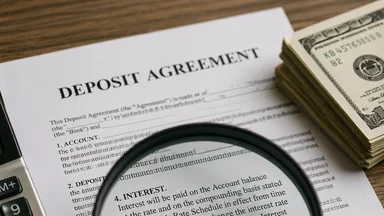
Open a checking account and you get a debit card, a mobile app, and a warm feeling that your cash is safe. Read the deposit agreement—the document nobody clicks through—and you find something else: a sentence that says your money becomes the property of the bank. Chase's deposit agreement states: "Funds you deposit become our property." The account is a liability on the bank's balance sheet, not a vault holding your belongings. Legally, you have made an unsecured loan. The bank promises to repay it on demand, but that promise rests on a stack of fine print that most depositors never see.
The Sentence Nobody Reads in the Deposit Agreement
Standard deposit agreements from large U.S. banks contain language like this: “Funds you deposit become our property and are not held in trust, as an agent, or in a fiduciary capacity.” That sentence is not buried in a footnote. It is usually in the first few pages, under a heading like “Ownership of Deposits.” Most people skip it because they assume the bank is a glorified safety-deposit box. It is not.
The legal foundation is the Uniform Commercial Code, specifically Article 4, which governs bank deposits and collections. Under UCC Section 4-104, a deposit creates a “debtor-creditor relationship.” The bank is the debtor; you are the creditor. Your balance is an unsecured claim against the bank’s assets, ranking alongside other general creditors in a bankruptcy proceeding.
FDIC insurance complicates the picture. The Federal Deposit Insurance Corporation guarantees up to $250,000 per depositor per bank, but that insurance kicks in only when the bank fails. It does not protect against the bank using your money to make loans, buy securities, or pay bonuses. The insurance is a backstop, not a safe.
Consider a real-world example: in 2023, First Republic Bank, a mid-size regional lender, was seized by regulators and sold to JPMorgan Chase. Most depositors were made whole, but the process took several days during which some customers could not access their full balances. The fine print had already warned that funds become the bank's property—and when the bank stumbles, that property is at risk.
Why a Checking Account Is a Loan You Make to the Bank
In ordinary life, you put cash in a safe and retrieve the same bills later. That is a bailment: the custodian holds your property and returns it unchanged. A bank deposit is the opposite. You hand over dollars, and the bank gives you a claim—a digital entry—that it will pay you back on demand. The bank is free to lend your money to someone else, to buy bonds, or to fund its own operations.
The interest the bank pays—if it pays any—is the price it offers for the use of your money. As of late 2024, many checking accounts yield 0.01% or less, while the bank lends those same dollars at 6–8% for mortgages or 10–15% for credit cards. The spread, called net interest margin, is the bank’s core profit engine. In 2023, the average net interest margin for U.S. banks was roughly 3.3%, according to FDIC data.
Fractional reserve banking amplifies this. Banks are required to hold only a fraction of deposits as reserves—currently 0% for most accounts, though they still manage liquidity internally. Each dollar you deposit can be lent out, redeposited, and lent again, multiplying the economic impact. Your single dollar can support several dollars of credit elsewhere. You are not storing money; you are supplying raw material for the lending machine.
When you write a check or swipe a debit card, you are instructing the bank to transfer part of your claim to someone else. The bank settles that instruction by moving entries on its own books or through the Federal Reserve system. No actual cash moves. Your balance is a ledger entry, nothing more.
To illustrate the scale: if you keep $5,000 in a checking account earning 0.01% for a year, you earn $0.50. The bank, lending that $5,000 at an average rate of 7%, earns $350. After accounting for operating costs and defaults, the bank might net $150 from your money. That is 30,000 times what you earn. The asymmetry is not an accident; it is by design.
The Federal Reserve's 1913 Ruling That Upended Deposits
Before the Federal Reserve Act of 1913, the legal status of bank deposits was murky. Some courts treated deposits as bailments, meaning the bank held your money as a custodian. That implied the bank could not use the funds for its own purposes without your explicit consent. The goldsmith bankers of 17th-century London operated that way: they stored gold and issued receipts, but the gold remained the depositor's property.
The landmark case that shifted the framework was Marine Bank v. Fulton Bank (1865), where the U.S. Supreme Court ruled that a deposit creates a debt, not a bailment. The bank owns the money outright; the depositor owns a claim. The Federal Reserve Act codified this view by establishing the central bank's role in clearing checks and managing reserves, treating deposits as liabilities of the banking system.
By the 1920s, the debtor-creditor model was settled law. Banks could lend deposits freely, and depositors had no right to demand specific bills or coins. The only protection was the bank's promise to pay on demand, backed by its capital and later by FDIC insurance. This legal fiction—that your money is really a loan—is the foundation of modern banking.
Some legal scholars argue that the debtor-creditor model is outdated in an era of electronic money. If your balance is just a digital number, what does the bank actually owe you? The answer is still the same: a promise to pay legal tender on demand. But the mechanics matter less than the relationship. You are a lender, not a customer buying storage.
A counter-argument worth considering: some depositors prefer the current system because it enables instant payments and widespread credit availability. If banks could not lend deposits, mortgage rates would be higher, and consumer credit might be scarce. The trade-off is that depositors accept risk in exchange for convenience. The fine print simply makes that trade-off explicit.
How Banks Profit When You Keep Your Money Idle
The most profitable depositor for a bank is one who keeps a high balance, makes few transactions, and never overdrafts. That depositor provides cheap funding. Banks take that funding and lend it at higher rates, earning the spread. In 2023, the five largest U.S. banks reported net interest income of roughly $250 billion combined, according to their annual filings.
Service fees add another layer. Overdraft and non-sufficient funds fees alone generated about $9–11 billion annually for U.S. banks in recent years, per FDIC data. Monthly maintenance fees, ATM fees, and paper-statement fees chip in further. The timing of a deposit posting can trigger multiple charges if it arrives after the cutoff time, causing a cascade of fees.
Low interest on checking is itself a form of profit. If a bank pays 0.01% on deposits and earns 3.3% on loans, the spread is 3.29%. On a $10,000 balance, that yields $329 per year for the bank. Multiply by millions of accounts, and the numbers become enormous. Banks also use deposits to fund securities portfolios, earning yields that fluctuate with the bond market.
The asymmetry is stark: depositors accept near-zero returns because they value liquidity and convenience. Banks exploit that preference to generate steady profits. It is not illegal, and it is not hidden—it is just buried in the fine print and the routine of everyday banking.
Consider a specific comparison: a high-yield savings account from an online bank might offer 4–5% APY, while a traditional brick-and-mortar checking account offers 0.01%. The difference on a $10,000 balance is about $400–$500 per year. Why would anyone keep money in a low-yield checking account? Often because they need immediate access or because they want to avoid monthly fees that would eat the interest. The trade-off between yield and convenience is a personal decision, but the fine print ensures the bank profits either way.
The 'Free Checking' Myth and Hidden Costs
“Free checking” sounds like a deal, but the fine print usually attaches strings. The account might require a minimum daily balance of $1,500, or a direct deposit of at least $500 per month, or a certain number of debit card transactions. Fail any condition, and a monthly maintenance fee of $10–15 appears. Some banks waive the fee only if you also have a linked savings account or a credit card.
ATM fees are another trap. Using an out-of-network machine can cost $2–5 from the ATM owner plus another $2–3 from your own bank. That is $4–8 for a single withdrawal. International ATM fees are even higher, often $5 plus a percentage of the amount. Credit card rewards structures sometimes pay higher returns to borrowers who never carry a balance, but that dynamic is different from checking account fees.
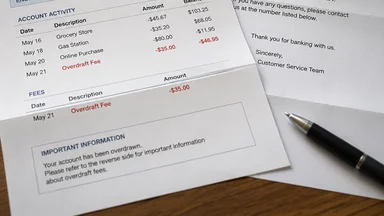
Non-sufficient funds fees averaged about $30–35 per occurrence in 2023, according to Bankrate surveys. Some banks charge a “sustained overdraft” fee if the account remains negative for several days. Others reorder transactions from largest to smallest to maximize the number of overdrafts per day. The Consumer Financial Protection Bureau has proposed rules to limit these practices, but as of late 2024, many banks still use them.
Paper statement fees, account inactivity fees, and closure fees (if you close the account within 90 days) add to the list. The deposit contract spells out every fee, but the average person never reads it. A one-hour review could reveal $100–200 in potential annual charges that are easy to avoid once you know they exist.
For example, Bank of America's standard checking account has a $12 monthly maintenance fee, but it is waived if you maintain a minimum daily balance of $1,500 or have a qualifying direct deposit of at least $250. If you slip below that balance for one day, the fee hits. Over a year, that is $144—enough to buy a modest dinner or a streaming subscription. The fine print defines the conditions precisely, but most customers never memorize them.
What Happens to Your Money When the Bank Fails
When a bank fails, the FDIC steps in as receiver. It typically pays insured depositors up to $250,000 within a few business days, often by transferring accounts to a healthy bank. But if you have more than $250,000 in a single account, the excess becomes an uninsured claim. You become a general creditor of the failed bank's estate, lining up behind secured creditors and ahead of shareholders.
The Silicon Valley Bank failure in March 2023 illustrated this starkly. Roughly 89% of its deposits were uninsured, far above the $250,000 limit, because the bank served venture capital firms and startups with large cash balances. The FDIC used a systemic risk exception to cover all deposits, but that was extraordinary. In a normal resolution, uninsured depositors might wait months and receive only a fraction of their funds.
Bankruptcy law prioritizes secured creditors first—those who hold collateral. Unsecured depositors are in a lower tier. If the bank's assets are insufficient, depositors take a haircut. The FDIC's insurance fund is funded by assessments on banks, not by taxpayer money, but it can be exhausted in a wave of failures. The 2008 crisis saw dozens of banks fail, and the fund had to borrow from the Treasury temporarily.
p>Credit unions offer a different structure. They are member-owned cooperatives, and their deposits are insured by the National Credit Union Administration up to $250,000. But the legal relationship is similar: your share account is an ownership stake, and the credit union can lend your money to other members. The difference is governance, not legal status.To put the risk in perspective: since the FDIC was created in 1933, no insured depositor has lost a penny of insured funds. But uninsured depositors have taken losses in many failures. If you have more than $250,000 at one bank, spreading the money across multiple institutions or using a deposit placement service like CDARS can keep you fully insured. The fine print doesn't warn you about concentration risk—it just defines the limits.
Reading Your Deposit Contract for One Hour Could Save Thousands
The deposit agreement is a contract, and like any contract, it binds both parties. Most people never read it because they assume the terms are standard or that they have no negotiating power. Both assumptions are partly true, but the details vary by bank. A one-hour review can uncover clauses that cost you money over time.
Start with the section on “Funds Availability.” Banks can hold deposits for several business days, especially for large checks or new accounts. If you need that money urgently, a hold can trigger overdrafts. The agreement will specify the hold schedule, which is often longer than the federal regulation mandates.
Check the fee schedule for “monthly maintenance,” “excess transaction,” and “returned deposit” fees. Some banks charge a fee if you deposit more than a certain number of checks per month. Others charge for using a human teller instead of an ATM. The definition of terms in contracts can have outsized consequences, as seen in disability insurance policies where the wording determines eligibility.
Look for clauses on “account closure” and “dormancy.” Banks may close your account after 12 months of inactivity and charge a fee. They may also escheat unclaimed property to the state after a certain period. If you have a forgotten account with a small balance, the bank might take it as a fee before turning it over.
p>Finally, note the arbitration clause. Many deposit agreements require you to resolve disputes through arbitration rather than a lawsuit, and they waive class-action rights. That means if the bank charges an unlawful fee, your only recourse is individual arbitration, which is rarely worthwhile for small amounts. The clause is often in the fine print, but it shapes your legal options.The deposit agreement is a contract that defines your relationship with the bank. It makes clear that your money is a loan, not storage. Understanding that fact won't change the banking system, but it can help you avoid unnecessary fees and make more informed choices about where to keep your cash.
For instance, if you regularly maintain a $5,000 balance, a high-yield savings account at an online bank paying 4% APY could earn you $200 per year, compared to $0.50 in a typical checking account. The trade-off is that you may have to wait a day or two to transfer funds to checking. The fine print of the savings account will also reveal that it is a loan to the bank, but at least you are being paid a market rate for that loan.
Another practical step: set up alerts for low balances and fee triggers. Most banks allow you to receive text or email notifications when your balance drops below a threshold. That can prevent overdraft fees and maintenance fee surprises. The fine print tells you the thresholds; alerts help you stay above them.
This article is for informational purposes only and does not constitute personalized financial or legal advice. Consult a qualified professional for advice tailored to your situation.