Checking Account Fee That Hits Twice When Your Deposit Posts One Hour Late
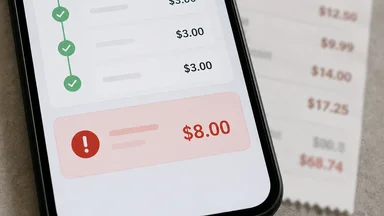
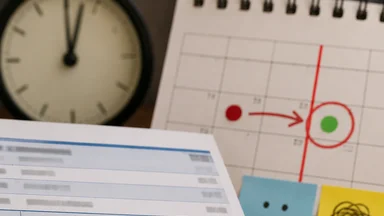
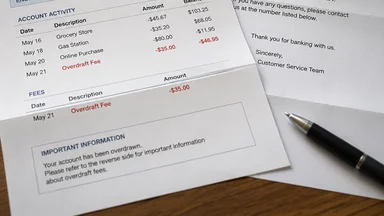
Imagine your paycheck direct deposit arrives at 5:01 PM on a Friday. Your bank's cutoff is 5:00 PM. That one-minute difference means the deposit won't post until Monday. Meanwhile, a rent check you wrote earlier in the week clears on Friday afternoon, leaving your balance negative. The bank charges an overdraft fee—typically $30 to $35. Then it charges a returned-item fee—another $30 to $35—when a subsequent debit is rejected. Two fees, one timing miss, and you're out roughly $60 to $70 before Monday morning.
The One-Hour Late Deposit That Triggers Two Fees
The scenario above is not rare. Many banks set a daily cutoff for deposit posting—often 5:00 PM Eastern, though some use 4:00 PM or 6:00 PM. Deposits received after that time are credited the next business day. For a Friday evening deposit, that means Monday. For a holiday weekend, Tuesday. The delay itself is a standard banking practice, but the consequences for consumers with low balances can be severe.
When a deposit is delayed, pending transactions—checks, debit card purchases, automatic payments—may still be processed. If the account lacks sufficient funds, the bank covers the transaction and charges an overdraft fee. If the bank declines a transaction, it charges a nonsufficient funds (NSF) fee, also called a returned-item fee. Both fees often land on the same account for the same batch of transactions. Industry estimates suggest that such paired fees generate billions of dollars in annual revenue for large banks.
The Consumer Financial Protection Bureau (CFPB) has studied this pattern. In a 2023 report, the agency found that consumers who incurred one overdraft fee were likely to incur multiple fees in a short period. The median overdraft fee among large banks was roughly $30 to $34 as of late 2024, with some institutions charging as high as $38. Combined with a returned-item fee of similar magnitude, a single late deposit can cost a consumer more than many streaming subscriptions or a week's worth of groceries.
Banks argue that fees are disclosed in account agreements and that consumers can avoid them by maintaining a buffer. But for those living paycheck to paycheck, a buffer of several hundred dollars is often out of reach. The timing of a deposit—something the consumer may not control if an employer submits payroll late—can trigger fees that compound quickly.
How Banks Sequence Deposits to Maximize Penalties
Beyond cutoff times, the order in which banks process transactions can multiply fees. Many banks use a high-to-low posting order: they process the largest transaction first, then smaller ones. This practice, which became widespread after court rulings in the 2010s, maximizes the number of overdraft fees. Suppose you have $100 in your account and three debits: a $90 rent check, a $20 utility payment, and a $10 coffee. Under high-to-low, the $90 clears first, leaving $10. The $20 utility then triggers an overdraft fee, and the $10 coffee triggers another. If processed low-to-high, only one fee might occur.
The CFPB and several state attorneys general have challenged this sequencing, but the practice remains legal as long as it is disclosed. A 2024 study by the CFPB estimated that high-to-low posting cost consumers roughly $1.5 billion in additional fees annually. Banks defend the practice by saying it prioritizes larger, more important payments like rent or mortgage, but critics argue it primarily benefits bank profits.
Deposit sequencing also matters. Some banks credit direct deposits immediately upon receipt, while others hold them until the cutoff. A deposit made at 4:59 PM may post that day; one at 5:01 PM waits. This rigid cutoff is a design choice, not a technical necessity. Real-time payment systems like FedNow and RTP process in seconds, but many banks still apply the cutoff to ACH and wire deposits. The result is that consumers who submit deposits just after the cutoff—through no fault of their own—face fees that could have been avoided minutes earlier.
The combination of high-to-low posting and delayed deposit crediting creates a perfect storm for low-balance account holders. A single late deposit can cascade into multiple fees, each one draining the account further. For someone earning minimum wage, that sum represents several hours of labor.
The Hidden Cost of Account Closure Threats
Repeated overdraft and returned-item fees can lead to account closure. Banks may close accounts that remain negative for a certain period—often 30 to 60 days—or that incur excessive fees. Once closed, the consumer's name may be reported to ChexSystems, a consumer reporting agency that tracks bank account mismanagement. A negative ChexSystems record can prevent the consumer from opening a new checking account at most banks for up to five years.
Consumers can request a free copy of their ChexSystems report once per year, similar to a credit report. Additional copies may cost a small fee, typically $0 to $12 depending on state law. But many consumers are unaware of this right or of the existence of ChexSystems at all. When they apply for a new account and are denied, they often learn of the report for the first time.
Account closure can disrupt direct deposits, automatic bill payments, and everyday spending. Consumers may be forced to switch to prepaid debit cards or check-cashing services, which carry their own fees. Check-cashing stores typically charge 1% to 4% of the check amount, and prepaid cards may have monthly maintenance fees, reload fees, and transaction fees. In effect, the original bank fee compounds into a long-term shift to more expensive financial services.
Banks have an incentive to close accounts that generate more risk than revenue. But the closure itself can push consumers into the fringes of the financial system, where fees are higher and protections are weaker. A 2022 study by the Federal Reserve Bank of Philadelphia found that consumers with a ChexSystems record were more likely to use alternative financial services and less likely to have a traditional bank account five years later.
Regulatory Efforts That Failed to Stop the Pattern
In early 2024, the CFPB proposed a rule that would cap overdraft fees at $3 for large banks. The rule aimed to reduce what the agency called “junk fees” that disproportionately affect low-income consumers. The proposal faced immediate legal challenges from banking industry groups, who argued that the cap would force them to raise other fees or reduce services. As of mid-2026, the rule remains tied up in litigation, and most large banks continue to charge $30 to $35 per overdraft.
The Federal Reserve's interest rate policy also plays a role. Higher interest rates, which the Fed held steady through 2026, increase the value of deposits to banks. Fee income becomes less critical when net interest margins are wide, but banks have been slow to reduce fees voluntarily. Some regional banks, such as Huntington Bancshares and Regions Bank, have lowered overdraft fees to around $20 to $25 in recent years, but the largest institutions like JPMorgan Chase and Bank of America have kept fees near the industry ceiling of $35.
State-level efforts have seen mixed results. A few states, including New York and Illinois, have considered legislation to limit overdraft fees or require low-to-high posting order, but none have passed as of 2026. The lack of federal action leaves consumers dependent on bank-by-bank policies, which vary widely. A 2025 survey by Bankrate found that overdraft fees ranged from $10 at some online banks to $38 at traditional brick-and-mortar institutions.
Industry defenders argue that overdraft fees are a service: the bank covers a transaction that would otherwise be declined, saving the consumer embarrassment or late fees from merchants. They also point out that consumers can opt out of overdraft coverage for debit card transactions, preventing fees but risking declined purchases. But opting out does not protect against checks or automatic payments, which are processed regardless. The result is that consumers face a difficult choice between potential fees and potential disruption.
What a $70 Surprise Means for a Minimum-Wage Worker
For a worker earning the federal minimum wage of $7.25 per hour, a $70 fee represents nearly ten hours of labor before taxes. Even at $15 per hour—the minimum in some states—the fee consumes over four and a half hours of work. A single fee pair can wipe out a significant portion of a weekly paycheck, leaving less for rent, utilities, and food.
The impact cascades. If a consumer cannot pay a utility bill on time, they may incur a late fee. If a rent check bounces, the landlord may charge a returned-check fee, often $25 to $50. The original bank fee of $70 can trigger a chain of additional fees from other service providers. A 2024 study by the Urban Institute found that households that incurred an overdraft fee were 40% more likely to report food insecurity in the following month.
Minimum-wage workers often have little control over the timing of their pay. Many employers use payroll services that process direct deposits at a set time each pay period. If the deposit arrives after the bank's cutoff, the worker bears the cost. Some employers offer early wage access programs, but these often carry their own fees or require a subscription. The cycle of late deposits and fees can repeat every two weeks, draining hundreds of dollars from an already tight budget.
The financial industry has long argued that overdraft fees are a choice—consumers could maintain a buffer or track their balance. But for those living on the edge, a buffer of several hundred dollars is a luxury. A 2023 Federal Reserve survey found that 37% of U.S. adults would struggle to cover a $400 emergency expense. For these households, a $70 fee is not an inconvenience; it is a crisis.
Alternatives That Avoid the Double Fee Trap
Credit unions often charge lower overdraft fees than large banks. Many credit unions cap overdraft fees at $20 to $30, and some offer free overdraft protection transfers from a linked savings account. Credit unions are not-for-profit cooperatives, so their incentive to maximize fee income is smaller. A 2025 study by the Credit Union National Association found that the average credit union overdraft fee was $22, compared to $33 at large banks. However, credit unions may have stricter membership requirements, limited branch networks, or less sophisticated mobile apps, which can be a drawback for some consumers.
Online banks and fintech apps like Chime, Varo, and Current have introduced no-fee overdraft programs. Chime's SpotMe feature allows eligible customers to overdraw up to a certain limit—typically $20 to $200—with no fee. These programs are funded by optional tips or subscription fees. They are not available to everyone, but they represent a growing alternative to traditional overdraft practices. However, some fintechs have been criticized for opaque terms or sudden changes in eligibility. For example, in 2024, the fintech company Dave was fined $1.5 million by the Federal Trade Commission for misleading customers about the cost of its cash advance service, highlighting the need for caution when using such apps.
Consumers can also adjust their direct deposit timing. If your employer offers the option, you may be able to split your paycheck between two accounts or request that payroll submit deposits earlier in the day. Some banks allow you to set up alerts for low balances or pending transactions, giving you time to transfer funds from a savings account. Even a small emergency fund of $200 to $500 can prevent most overdraft fees, though building that fund is a challenge for many.
Another tactic is to use a prepaid card from a reputable issuer, such as the Bluebird by American Express or the Walmart MoneyCard. These cards typically have no overdraft fees because they do not allow spending beyond the loaded balance. Monthly fees can be $5 to $10, but that may be cheaper than a single overdraft fee pair. Some prepaid cards also offer early direct deposit access, crediting paychecks up to two days early.
Reading the Fine Print Before Opening an Account
The best defense against surprise fees is understanding the account agreement before signing. The fee schedule is often buried in a dense document, but key points can be found by searching for “overdraft,” “NSF,” and “cutoff.” Look for the exact dollar amounts and the frequency of fees—some banks charge a fee per day that an account remains overdrawn, which can multiply quickly.
Posting order policy is another critical detail. Banks are required to disclose whether they use high-to-low or low-to-high sequencing, but the language can be vague. Phrases like “transactions may be processed in any order” are red flags. Some banks explicitly state that they process larger items first. If the policy is not clear, call customer service and ask: “If I have a $100 balance and a $90 check and a $20 debit, how many overdraft fees will I be charged?” The answer will reveal the bank's approach.
Grace periods for deposits are rarely advertised, but some banks offer a buffer. A few institutions will waive the first overdraft fee per year or will not charge a fee if the overdraft is small—say, under $5. Others offer a 24-hour grace period to deposit funds before a fee is assessed. These features can make a significant difference for someone who occasionally runs close to zero.
Finally, compare the total cost of an account over 12 months, not just the monthly maintenance fee. An account with no monthly fee but high overdraft charges may be more expensive than one with a small monthly fee and low overdraft costs. Look for fee caps—some banks limit overdraft fees to four or five per day, which can prevent a cascade of fees from a single late deposit. A careful read of the fine print, combined with a realistic assessment of your own spending patterns, can save hundreds of dollars a year.
The Systemic Nature of the Problem
While individual actions like reading the fine print and choosing a credit union can reduce the risk of double fees, the problem is ultimately systemic. Banks design their fee structures and posting policies to maximize revenue from consumers with low balances. The cutoff times, high-to-low sequencing, and paired fees are not accidents—they are deliberate choices that have been upheld by courts and regulators for years. The CFPB's efforts to cap fees have stalled, and state-level reforms have failed to gain traction. As a result, consumers are left to navigate a patchwork of policies that favor the bank's bottom line over the customer's financial health.
Even the most informed consumer can fall victim to a timing miss beyond their control. An employer that submits payroll an hour late, a holiday that shifts the business day, or a technical glitch in the ACH system can all trigger the double fee trap. No amount of fine-print reading can protect against a deposit that arrives at 5:01 PM instead of 4:59 PM. The burden should not be on the consumer to outsmart a system designed to extract fees; it should be on regulators and banks to create a fairer structure. Until that happens, the double fee will continue to hit the most vulnerable consumers hardest, turning a one-hour delay into a financial crisis.
This article is for informational purposes only and does not constitute personalized financial advice. Consult a qualified professional for advice tailored to your situation.